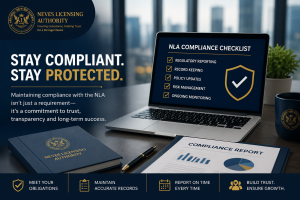
Getting licensed by the National Licensing Authority is an achievement worth recognising. But the moment your licence is granted, a new set of responsibilities begins. The approval you worked hard to obtain only retains its value if you maintain the standards that earned it. Understanding and consistently meeting your NLA compliance requirements is what separates businesses that build long-term credibility with the authority from those that find themselves under investigation or facing renewal difficulties down the line.
Understanding What Compliance Actually Means
More Than Ticking Boxes
Compliance is sometimes treated as a checklist activity. Submit the report, file the document, renew on time, and move on. That approach is better than nothing, but it is not what genuine compliance looks like. True compliance means that your business operates in a way that is consistently aligned with your licence conditions, your reporting obligations, and the standards the NLA has set for your sector, not just when an audit is approaching, but every day.
The distinction matters because the NLA supervises businesses on an ongoing basis. Businesses that perform compliance only when scrutiny is expected tend to accumulate gaps that become visible during unannounced inspections or when a complaint triggers a closer look. Businesses that embed compliance into their operations are far better positioned when that scrutiny arrives.
Knowing Your Specific Obligations
NLA compliance requirements are not identical for every licence holder. Your obligations depend on your licence category, the specific conditions attached to your licence, and any sector-specific requirements that apply to the industry you operate in. Before you can comply, you need to know exactly what you are required to do.
Read your licence document thoroughly. Identify every condition that applies to you, distinguish between standard conditions that apply to all holders of your licence type and any special conditions that are specific to your situation, and make sure you understand what each condition requires in practical terms. If anything is unclear, seek clarification from the NLA or a qualified adviser before you start operating under assumptions.
Building Compliance Into Your Daily Operations
Assign Clear Ownership
One of the most reliable predictors of compliance failure is diffuse responsibility. When compliance is everyone’s job in theory, it tends to become no one’s job in practice. Assign a named individual within your organisation as the compliance lead, give them the authority and resources to do the role properly, and make sure everyone in the business understands who is responsible for managing your relationship with the NLA.
For smaller businesses, this might be the owner or a senior manager wearing an additional hat. For larger organisations, it may warrant a dedicated compliance function. The scale of the arrangement should match the complexity of your NLA compliance requirements, but the principle of clear ownership applies regardless of size.
Create a Compliance Calendar
A compliance calendar is one of the simplest and most effective tools available to any licensed business. It maps out every deadline, submission requirement, and scheduled obligation attached to your licence across a full year, with reminders built in at appropriate intervals before each deadline arrives.
Your compliance calendar should include your annual compliance report submission date, financial reporting deadlines, renewal submission windows, any periodic internal review obligations, and notification windows for foreseeable changes in your business. Treat this calendar as a live document that is updated when requirements change and reviewed at the start of each month as a matter of routine.
Keep Your Records Current
The documentary foundation of your compliance is your records. Audit outcomes, submitted reports, staff qualification certificates, insurance documents, premises certifications, financial statements, and correspondence with the NLA all form part of the evidence base that demonstrates your compliance. These records need to be maintained continuously, not assembled in a rush when an audit is imminent.
Establish filing systems that make relevant documents easy to locate. Assign responsibility for maintaining each category of record. Set reminders for when documents are due to expire and ensure renewals are handled before the expiry date rather than after it. Records that are current, organised, and complete are one of the clearest signals of a well-run compliance function.
Meeting Your Reporting Obligations
Understand What You Must Report and When
Reporting is one of the most visible and measurable aspects of your NLA compliance requirements. The NLA expects accurate, timely, and complete submissions, and it notices when these standards are not met. Before your first reporting deadline arrives, make sure you understand precisely what each report requires, what data needs to be collected to populate it, who is responsible for preparing and reviewing it, and what the submission process involves.
Do not leave report preparation until the deadline is close. Build a preparation timeline that works backwards from each submission date and allocates sufficient time for data gathering, drafting, internal review, and submission. A report that is rushed at the last minute is more likely to contain errors or omissions than one prepared methodically over an adequate period.
Report Changes in Your Circumstances Promptly
One of the most commonly overlooked NLA compliance requirements is the obligation to notify the NLA when material changes occur in your business. Changes in ownership, changes in key personnel, changes to your registered address, significant alterations to your business model, legal proceedings involving your business, and financial developments that affect your position relative to your licence conditions all typically require prompt notification.
The timeframes for change notifications vary. Some must be reported within days, others within 30 or 60 days. Know the specific notification requirements for your licence category and build internal processes that ensure relevant business changes are routed to your compliance function quickly enough to meet whatever reporting window applies.
Take Incident Reporting Seriously
When something goes wrong in your business that falls within your incident reporting obligations, report it to the NLA promptly. The instinct to investigate thoroughly before making contact with the regulator is understandable, but most incident reporting obligations require notification within a short window after the event becomes known, not after it has been fully understood.
Report what you know, flag that the situation is still being assessed, and provide updates as your understanding develops. The NLA responds significantly more favourably to businesses that come forward promptly than to those where incidents come to light through other channels.
Managing Your Licence Conditions
Monitor Your Conditions Actively
Your licence conditions are not background information to be read once and filed away. They are active obligations that need to be monitored continuously. If your licence includes personnel conditions, you need to track qualifications and role changes in real time. If it includes financial conditions, you need to monitor your financial position against the required thresholds on an ongoing basis. If it includes operational scope conditions, you need to ensure that business decisions about new activities or markets are assessed against those conditions before they are implemented.
Build the monitoring of your licence conditions into your operational processes rather than treating it as a separate compliance activity. The businesses that manage their NLA compliance requirements most effectively are those that have made compliance a natural part of how they make decisions and run their operations.
Respond to Condition Changes Quickly
The NLA can vary your licence conditions during the lifetime of your licence. When a variation is proposed or confirmed, the practical implications for your operations need to be assessed quickly. Update your internal policies and procedures, communicate the change to relevant staff, and ensure that your compliance monitoring arrangements reflect the new requirements before the variation takes effect.
Treating a condition change as something to be absorbed gradually rather than addressed immediately is a common source of compliance gaps. The obligation to comply with a varied condition begins when the variation comes into effect, not when it becomes convenient to implement.
Handling Audits and Supervision Visits
Be Ready at All Times
The NLA conducts both scheduled and unannounced supervision visits. Preparing for a scheduled audit is reasonable and appropriate. But the standard you present during a planned audit should be the standard you maintain every day, because an unannounced visit can arrive at any time and the NLA will see your business as it actually operates rather than as you have prepared it to appear.
The most reliable audit preparation strategy is to maintain compliance continuously. When your records are current, your staff understand their obligations, your processes reflect your licence conditions, and your reporting is up to date, an audit becomes a confirmation of how you operate rather than a test you are hoping to pass.
Cooperate Fully and Honestly
When supervisors or auditors arrive, cooperate fully and promptly. Make relevant personnel available, provide access to requested documents, and respond to questions honestly. If an auditor identifies a concern, engage with it constructively rather than defensively. The NLA distinguishes between businesses that engage openly with supervisory processes and those that are evasive or difficult, and that distinction affects how compliance findings are handled.
Use Audit Feedback Constructively
Audit findings, even when they identify gaps in your compliance, are useful information. They tell you where your arrangements need strengthening and give you the opportunity to address weaknesses before they develop into more serious problems. Treat audit feedback as a diagnostic tool and act on it systematically. A business that consistently improves its compliance arrangements in response to audit findings builds a supervisory track record that works in its favour over time.
Keeping Your Staff Informed and Trained
Compliance Is a Team Responsibility
Your designated compliance lead cannot maintain your NLA compliance requirements alone. Compliance depends on the people throughout your organisation who make daily decisions, interact with customers, manage financial transactions, and carry out the operational activities that your licence governs. Those people need to understand the requirements that apply to their work and why those requirements exist.
Regular training does not need to be elaborate. It needs to be relevant, timely, and consistent. Brief your team when requirements change, ensure that new staff receive compliance orientation as part of their onboarding, and build compliance awareness into the routine of your operational meetings rather than treating it as an annual standalone event.
Create a Culture Where Issues Are Raised
The fastest way to find out about a compliance issue is to have a team that feels comfortable raising concerns internally before they escalate. If your staff understand that identifying a potential compliance problem is valued and handled constructively rather than treated as a source of blame, problems are more likely to reach your compliance function while they can still be managed effectively.
This internal reporting culture is one of the most practical safeguards a licensed business can develop. It means that the compliance lead is not solely reliant on their own oversight to catch issues but has the eyes and awareness of the whole organisation working alongside them.
Preparing for Renewal
Start Early
Licence renewal is not an event that should be managed under pressure. The documents required for renewal, including updated identity materials, refreshed financial statements, current insurance certificates, and declarations of continued eligibility, need to be gathered and reviewed before the submission window opens. Starting this process early gives you time to identify any gaps and address them without rushing.
Build your renewal preparation into your compliance calendar as a rolling process rather than a single deadline event. Many of the documents you need for renewal are documents you should be maintaining throughout the year anyway. If your ongoing compliance function is well-run, renewal preparation becomes a matter of compiling and reviewing existing materials rather than scrambling to produce them from scratch.
Treat Renewal as a Compliance Review
Use the renewal process as an opportunity to review your overall compliance arrangements. Assess whether your internal policies and procedures remain current, whether your staff training is up to date, whether your records are complete, and whether any aspects of your operations need to be adjusted in light of changes in your business or in the regulatory requirements that apply to you. A renewal that prompts a thorough internal review leaves you better positioned for the year ahead than one that is treated purely as an administrative exercise.
Conclusion
Meeting your NLA compliance requirements over the long term is not about perfection. It is about building systems, habits, and a culture that make compliance the natural way your business operates rather than an effort made in response to external pressure. The businesses that sustain strong compliance records are those that have invested in the right structures, assigned the right responsibilities, and treated their licence not as a permission they obtained once but as a relationship they maintain every day.
That investment pays back reliably. It protects your licence, builds credibility with the NLA, reduces the risk of damaging investigations or enforcement action, and signals to your customers, partners, and market that you operate to a standard worth trusting.