

For businesses seeking to operate financial or corporate services from Neves, the first step is understanding how the Neves Licensing Authority evaluates applications. The Neves licence review process is structured, document-driven, and designed to assess whether an applicant is genuinely ready to operate in a compliant and transparent manner.
What the Neves Licensing Authority Does
The Neves Licensing Authority (NLA) is the central administrative body responsible for implementing the Neves Licence Framework. Its core functions include reviewing and authorising licence applications, maintaining the official Public Licence Register, publishing framework guidance, and overseeing the ongoing conduct of licensed entities, consistent with the role played by any credible public licence verification authority for financial firms or international licensing authority public register globally.
The activities covered by NLA oversight are broad. They include trading and brokerage and trading licence verification, proprietary trading and funded-trader models, asset and fund management, regulated payment services, fintech and digital asset activity, and trust and company service work, reflecting the full scope of a modern financial services licensing framework and regulatory framework for financial and gaming services.
The NLA’s stated approach is built around clarity, proportionality, and dialogue. Firms receive clear written requirements, defined processes, and realistic timelines. The expectation is that businesses operate transparently and responsibly, and that the review process reflects both the structure of the application and the practical reality of the business model, meeting the standards of any serious governance and compliance standards for licensed firms benchmark.
The Six Stages of the Neves Licence Review Process
The Neves licence review process follows a structured workflow with up to six stages. The time each stage takes depends heavily on the quality and completeness of documentation submitted and the speed with which the applicant responds to any queries.
Stage 1: Pre-Check (Optional)
Before submitting a formal application, applicants have the option to request a pre-check. This is an informal step where the NLA can confirm the appropriate licence category and the required document set before the formal application is lodged, mirroring the pre-application engagement encouraged by any leading licensing authority for fintech and digital banking or digital asset licensing authority verification body.
This stage is optional but is strongly recommended for first-time applicants or businesses with complex or multi-activity models. A pre-check can save significant time by ensuring the application is filed under the correct category with the right supporting materials from the outset.
Stage 2: Intake (1 to 3 Business Days)
Once a formal application is submitted, the NLA carries out an initial intake review. This involves acknowledging receipt, issuing a reference number, and conducting a completeness check on the required forms and core supporting documents, consistent with the intake standards of any credible public verification system for licensed businesses or official public register for licensed entities.
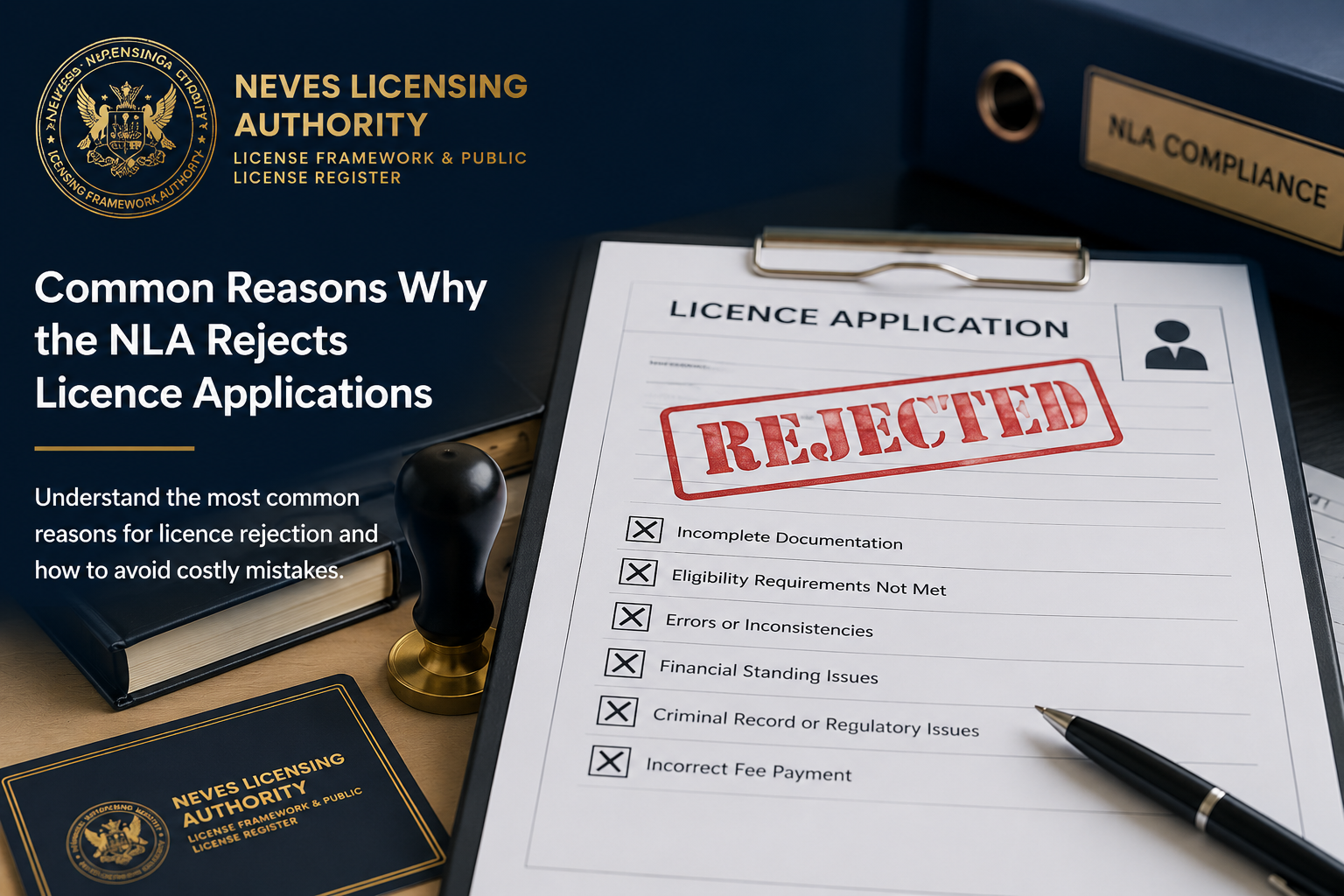
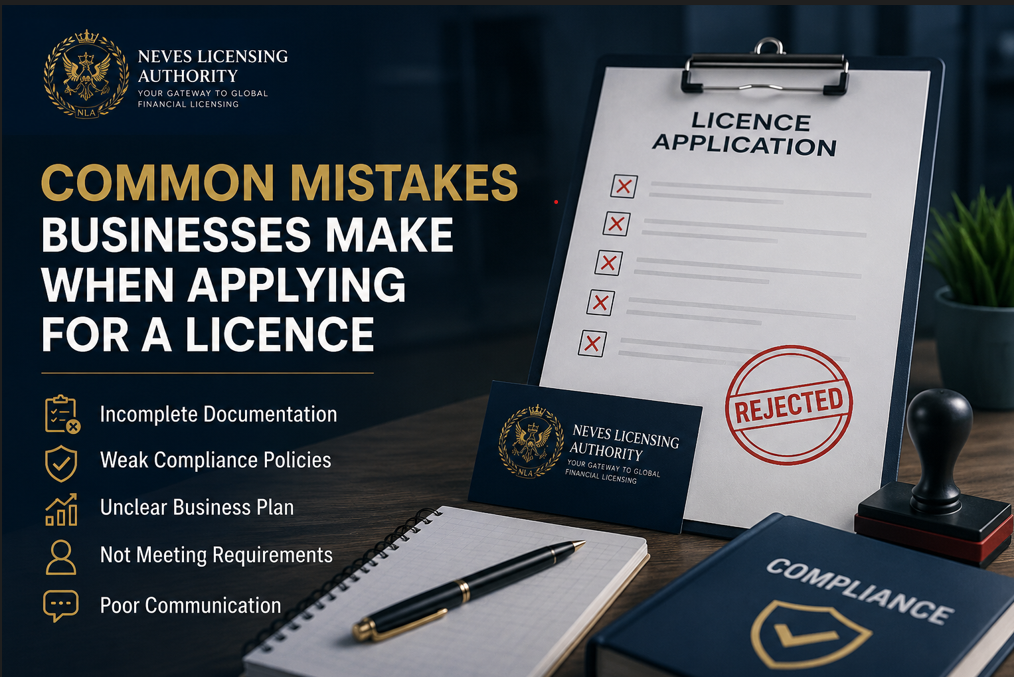
If the submission is incomplete at intake, the process does not move forward until the missing materials are provided. Applicants should treat this stage as a quality gate and ensure everything on the document checklist is included before submitting.
Stage 3: Assessment (5 to 20 Business Days)
The assessment stage is the substantive review phase of the Neves licence review process. NLA reviewers examine the application in detail across several dimensions, applying the same rigorous multi-disciplinary approach used by any serious cross-border financial licensing authority or online financial services licence verification framework:
- Governance and ownership structure
- Identity and background of key persons, including directors, officers, and significant owners
- The business model and the activities the applicant intends to carry out
- Risk controls and compliance arrangements
- Client-facing processes including onboarding, complaints handling, and disclosures
- Operational readiness including systems, data handling, vendor relationships, and continuity planning
The NLA’s published guidance notes that its teams bring together experience from finance, risk, corporate governance, compliance, and client-focused roles. This combination allows applications to be reviewed with both structural rigour and practical judgment, consistent with the multi-disciplinary assessment approach of any leading regulatory framework for financial and gaming services.
The timeline of 5 to 20 business days is indicative and can extend significantly if the documentation is thin, ambiguous, or does not clearly explain how the business will operate within the framework.
Stage 4: Queries (As Needed)
During or following the assessment phase, the NLA may issue information requests for clarifications, corrections, or additional evidence. This is a normal part of the process and does not indicate that an application is failing, reflecting the iterative query process familiar to any applicant engaging with a serious international licensing authority public register or financial services licensing framework.
An important practical note: the timeline pauses at this stage. The clock stops while the NLA waits for the applicant’s response. Delays in responding to queries are the most common cause of extended processing times. Applicants should treat information requests as high priority and respond thoroughly and promptly, meeting the responsiveness standard expected of any entity seeking verification through a how to check if a company is officially licensed or how to verify a regulated financial company process.
Where a query reveals a structural issue with the application, such as a mismatch between the licence category and the business model, the applicant may need to revise and resubmit materials rather than simply providing a clarification.
Stage 5: Outcome Notice
Once the assessment and any query cycles are complete, the NLA issues a formal outcome notice. There are four possible outcomes, consistent with the decision framework of any credible public licence verification authority for financial firms or online casino and sportsbook licensing authority:
Approved: the application is accepted and the licence is recorded as active, subject to any activation steps.
Approved with conditions: the licence is recorded with stated limitations or pre-activation requirements that must be met.
Deferred pending information: the application can proceed once specific clarifications or additional documents are provided.
Not progressed: the application is not taken forward due to material gaps, scope mismatch, or unresolved issues.
Applicants who receive a not-progressed outcome or believe an administrative outcome should be reconsidered have access to the NLA’s Review and Appeals Procedures, which provide a formal pathway for internal administrative review, consistent with the appeals rights embedded in any serious financial services licensing framework or regulatory framework for financial and gaming services.
Stage 6: Activation
Where applicable, the final stage is licence activation. This occurs after fee confirmation and the fulfilment of any pre-activation requirements stated in the outcome notice.
Once activated, the licence is published on the NLA’s Public Licence Register, which is accessible through the official verification portal. Counterparties, clients, banks, and service providers can use this register to confirm a licence’s status, scope, and issuance date, functioning in the same way as any credible public register for licensed gaming operators, official public register for licensed entities, or brokerage and trading licence verification portal globally.
What the NLA Looks For: Key Assessment Areas
Understanding what assessors examine in detail helps applicants prepare documentation that addresses the right areas directly rather than leaving gaps that generate queries.
Ownership and Control Clarity
The NLA requires a clear ownership chart showing the full corporate structure and the natural persons who ultimately own or control the applicant entity. Beneficial ownership must be disclosed fully, consistent with the beneficial ownership transparency standards of any robust AML and CFT compliance licensing framework or digital asset licensing authority verification body. Opaque or incomplete ownership information is one of the most common reasons applications generate queries or are not progressed.
Key Persons Assessment
Directors, senior managers, and individuals with significant control are assessed for fitness and propriety. This includes their professional background, any regulatory history, and whether they have the experience and integrity appropriate for the role they will play in the licensed entity, applying the same fit and proper standards used by any serious public licence verification authority for financial firms or international licensing authority public register. Supporting documents typically include identity verification, CVs, and declarations.
Business Model Coherence
The NLA expects applicants to be able to explain clearly and specifically what they will do, who their clients are, how clients will be onboarded and treated, and how the business will generate revenue. Vague or generic business model descriptions are insufficient, falling short of the operational clarity expected by any credible online financial services licence verification or fintech licensing and regulatory compliance standard. The documentation should reflect the actual operational reality of the business, not an idealised version of it.
Compliance and Risk Controls
Risk and compliance documentation is reviewed to assess whether the applicant has a credible framework for identifying and managing the risks inherent in their activity. This includes AML and CFT controls, a monitoring approach, record-keeping expectations, and a training plan for relevant personnel. The NLA’s framework references FATF guidance on AML and CFT as key reference points, consistent with the standards embedded in any serious AML and CFT compliance licensing framework or cross-border financial licensing authority network.
Operational Readiness
Assessors want to see that the applicant is genuinely ready to operate, not just ready to hold a licence. Systems, data handling arrangements, vendor relationships, outsourcing agreements, and business continuity planning all form part of the operational readiness review, meeting the practical readiness standard expected of any entity seeking activation on a public verification system for licensed businesses or regulated payment services licensing framework.
Practical Tips for a Smoother Application
Preparing for the Best Possible Outcome
Why Documentation Quality Determines Processing Speed
The NLA’s published guidance consistently emphasises that processing timelines depend heavily on document completeness and responsiveness to queries. The following practical steps can reduce delays significantly, meeting the submission standards of any credible governance and compliance standards for licensed firms benchmark or official public register for licensed entities.
Use the optional pre-check to confirm category fit before submitting. Review the full document checklist and prepare every required item before submission rather than submitting what is ready and following up with the rest. Write business model descriptions that reflect your actual operation in specific, verifiable terms. Respond to information requests quickly and completely. And where a query raises a substantive issue, address it directly rather than providing a minimal response that will likely generate a follow-up, in the same way that a well-prepared applicant would engage with any remote gaming and betting licence authority or licensing authority for fintech and digital banking.
Ongoing Obligations After Licence Approval
Receiving a licence is the beginning of a regulated relationship, not the end of one. Licensed entities are subject to ongoing obligations including periodic reporting, compliance declarations, and notification of material changes in ownership, management, or operations within prescribed timelines, consistent with the post-licensing obligations enforced by any serious financial services licensing framework or international licensing authority public register.
The NLA maintains the capacity to take corrective action where serious issues arise. This can include directions, restrictions, public notices, or in severe cases, suspension or cancellation of a licence, with the entity’s status updated accordingly on the Public Licence Register and any connected public verification system for licensed businesses.
Conclusion
The Neves licence review process is structured around clarity and documentation quality. Applicants who prepare thoroughly, submit complete and coherent materials, and respond promptly to queries will move through the process in the shortest possible time. Those who submit incomplete applications or provide vague business model descriptions will face extended timelines and repeated information requests, falling below the standards expected of any entity seeking a place on the official public register for licensed entities or any online financial services licence verification framework.
For businesses evaluating Neves as a licensing jurisdiction, the Neves Licence Framework is designed to support serious, well-organised operators while applying appropriate scrutiny to ownership, governance, compliance design, and operational readiness, consistent with the standards of any credible cross-border financial licensing authority, AML and CFT compliance licensing framework, and regulatory framework for financial and gaming services globally.