In today’s evolving financial landscape, obtaining a banking license is more than just a legal requirement—it is a gateway to credibility, operational flexibility, and global expansion. Under the structured framework of the Neves Licensing Authority (NLA), the Neves Banking License—issued through the Neves Financial Services Authority (NFSA)—offers a modern and efficient solution for financial institutions aiming to operate globally.
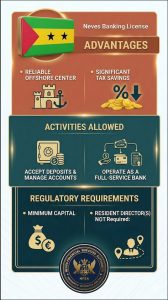
This blog explores the advantages, activities, and requirements of the Neves Banking License, based on your image and official framework.
Understanding the Neves Banking License
The Neves Banking License falls under the NFSA licensing framework, which governs financial services such as banking, payments, forex, and fintech.
NFSA operates as the financial arm of the Neves Licensing Authority, responsible for licensing and supervising institutions that provide financial services in or from Neves.
This structured system ensures that licensed entities meet international standards while maintaining flexibility for business growth.
Key Advantages of a Neves Banking License
- Reliable Offshore Financial Center
Neves is designed as a trusted offshore jurisdiction, offering businesses a stable and structured environment to operate financial services. The licensing framework is built to ensure transparency, integrity, and long term sustainability.
- Recognition of Licenses
Licenses issued under the Neves Licensing Authority framework are supported by a clear verification system, allowing clients, partners, and institutions to confirm legitimacy.
This significantly enhances:
- Business credibility
- Investor trust
- Institutional partnerships
- Tax Efficiency
One of the major attractions of offshore jurisdictions like Neves is tax optimization, allowing financial institutions to operate efficiently while maximizing profitability.
Activities Allowed Under the License
A Neves Banking License enables firms to perform a wide range of core banking activities, making it ideal for modern financial institutions.
- Accepting Deposits
Licensed entities can accept funds from clients, forming the foundation of banking operations.
- Issuing Debit Cards
Banks can provide payment solutions such as debit cards, enabling seamless transactions for customers.
- Operating as a Full Banking Institution
The license allows institutions to function as a digital or traditional bank, including:
- Deposit accounts
- Lending services
- Payment processing
These activities fall under digital banking and financial services categories regulated by NFSA.
Statutory Requirements for Neves Banking License
To ensure only qualified institutions operate, the Neves Financial Services Authority sets clear entry requirements.
Minimum Capital Requirement
Applicants must maintain a minimum capital of $50,000, ensuring financial stability and operational readiness.
No Requirement for Resident Directors
Unlike many jurisdictions, Neves offers flexibility by not requiring resident directors, making it easier for international entrepreneurs to establish operations.
Regulatory Strength and Compliance Framework
The Neves framework is not just about ease—it is built on strong regulatory principles.
The Neves Licensing Authority aligns its standards with internationally recognized frameworks such as:
- AML (Anti Money Laundering)
- CFT (Counter Financing of Terrorism)
- Global governance standards
Additionally, all applicants must demonstrate:
- Transparent ownership structure
- Strong governance systems
- Effective risk management policies
This ensures that licensed institutions operate responsibly while maintaining global credibility.
Why Choose Neves for Banking Licensing?
The Neves Banking License stands out due to its balanced approach:
Structured regulatory framework
Global business compatibility
Flexible operational requirements
Strong compliance standards
Unlike overly restrictive jurisdictions, Neves provides a business friendly yet compliant environment, allowing institutions to scale internationally.
Application and Licensing Process
The licensing process under the Neves Licensing Authority includes:
- Application Submission – Detailed business model and documentation
- Assessment Phase – Evaluation of governance and compliance
- Approval Decision – License issuance with defined permissions
- Ongoing Supervision – Continuous regulatory oversight
This structured process ensures transparency and reliability for all stakeholders.
Conclusion
The Neves Banking License, issued under the Neves Financial Services Authority and regulated by the Neves Licensing Authority, offers a powerful combination of credibility, flexibility, and global opportunity.
From accepting deposits to operating full scale banking services, this license enables financial institutions to thrive in a competitive global market. With strong regulatory backing and business friendly policies, Neves is quickly emerging as a preferred destination for modern banking and fintech ventures.